The Gas Lab · Field Guide No. 002
How much gas have I got left?
And why that rather convincing little pressure gauge is lying to you.

five minutes ago!
It's Sunday afternoon. The family is over. You've spent an unreasonable amount of money at the butcher, the braai is warming up and somebody asks the question nobody wants to hear:
Have we got enough gas?
Fortunately, you've bought a rather impressive little pressure gauge with green, amber and red markings. You glance at it. Green. Marvellous.
Twenty minutes later, you're discussing takeaway options.
So what happened? Well, your pressure gauge wasn't necessarily broken. It was simply measuring the wrong thing.
Let's explain.
The short version.
- Pressure is not quantity. A nearly empty gas bottle can have the same pressure as a full one.
- Temperature matters. A cold bottle will generally have a lower pressure than a warm one, regardless of how much gas is inside.
- Weight doesn't lie. Weighing your cylinder is one of the simplest and most dependable ways of determining how much gas remains.
- Ultrasound is rather clever. Suitable electronic sensors can measure the liquid level inside your cylinder without opening it.
- Running out is optional. A little planning, a spare cylinder or a managed gas supply can save you from an unexpectedly cold shower.
01.What's actually inside your gas bottle?
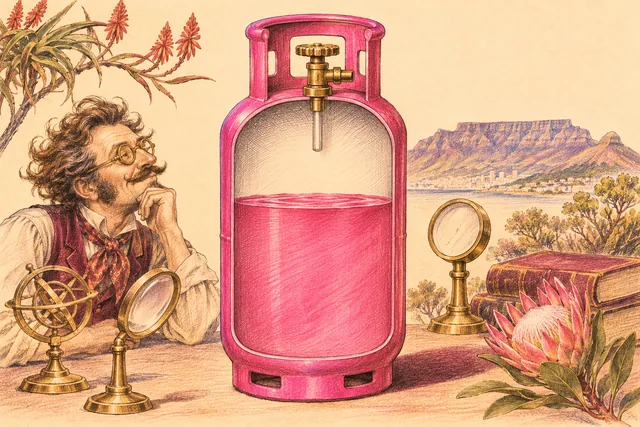
Vapour above. Physics doing its thing.Conceptual cutaway, not an engineering or installation drawing.
Here's something that might surprise you. Most of the LPG in a reasonably full gas cylinder is liquid.
LPG stands for Liquefied Petroleum Gas. The important word here is liquefied.
Inside your cylinder, you have liquid LPG at the bottom and LPG vapour in the space above it. When you turn on your hob, geyser or braai, vapour leaves the cylinder. Some of the liquid then evaporates to replace it.
Turn the appliance off and everything settles down again. This little process repeats itself throughout the life of your cylinder, from the day we deliver it to the day you phone us for another one.
It's rather ingenious. No pump, no moving parts, no batteries. Just physics quietly doing its thing.
And this is precisely why your pressure gauge has a problem.
02.The trouble with that little dial
Imagine three identical gas bottles sitting next to one another on a pleasant afternoon in Pretoria. One is nearly full. One is half full. One has just enough liquid left to make tomorrow morning's coffee.
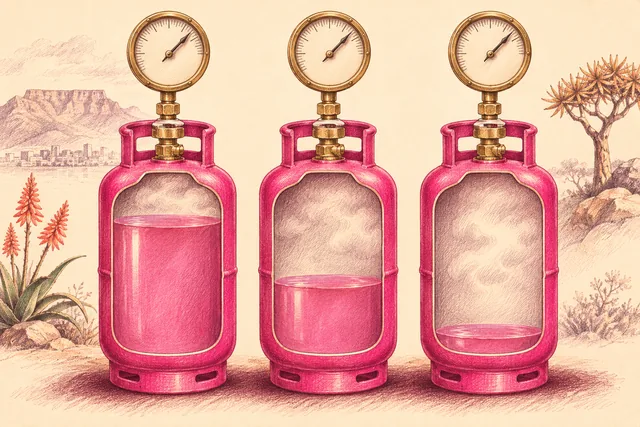
Connect a suitable pressure gauge to each and, assuming they're at the same temperature and contain the same LPG mixture, they'll show much the same pressure. Yes, really.
As long as there is liquid LPG remaining, the cylinder can replenish its vapour as gas is consumed. The pressure is largely determined by the temperature and composition of the LPG, rather than how much liquid remains.
Only once the last of the liquid has evaporated does the pressure begin to fall as the remaining vapour is consumed. By then, your useful early-warning system is telling you something you've probably already worked out. You're running out of gas.
A pressure gauge is a perfectly good instrument. It's just a terrible fuel gauge.
Those reassuring green, amber and red markings don't change the physics. They merely make it more colourful.
Don't believe us? Have a play.
Change the amount of gas in the cylinder, then change its temperature. Watch the pressure gauge.
Notice anything interesting?
At a fixed temperature, the modelled pressure stays the same regardless of the amount of liquid remaining.
Illustrative relative-pressure model, not a calibrated LPG calculator. Index 100 is the reference at 20°C. The displayed fill percentage refers to nominal LPG contents, not vessel volume. Actual pressure depends on LPG composition and operating conditions. No pressure prediction is made once liquid is gone.
03.Winter, summer and the occasional misleading needle
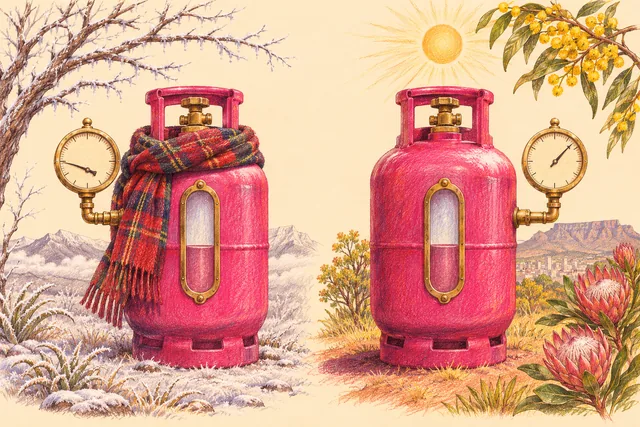
If you've ever used a gas appliance on a particularly miserable Highveld winter morning, you may have noticed that things behave a little differently.
LPG vapour pressure changes considerably with temperature. A cold cylinder generally has a lower pressure than a warm one.
To make things slightly more interesting, using gas actually cools the cylinder. Remember that liquid inside the bottle? Turning it into vapour requires energy, which it absorbs as heat from its surroundings. It's a similar principle to the cooling effect you feel when you step out of a swimming pool.
If you're running several gas appliances at once, your cylinder can become noticeably cold. Under certain conditions, you might even see condensation or frost on the outside.
Your pressure gauge may consequently suggest that you're running low when there's still plenty of LPG inside. The opposite can happen on a hot summer afternoon.
Same bottle. Same contents. Different reading.
Now you understand why we've never been particularly enthusiastic about selling pressure gauges as fuel gauges. And no, warming your cylinder artificially is not the solution. Keep it in its properly designed location, away from unnecessary heat sources.
04.Weight doesn't lie
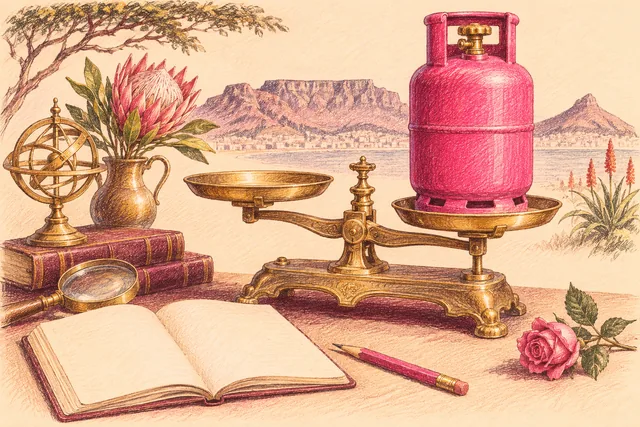
An exceedingly low-tech solution to a seemingly complicated problem.
Every refillable LPG cylinder has an empty weight, known in the trade as its tare weight. You will generally find this marked on the cylinder itself, often on its collar or shoulder.
That number tells you approximately how much the cylinder weighs without its gas. Weigh the cylinder, subtract its tare weight, and what's left is your LPG. No chemistry degree required.
Let's do the maths.
21.5 kg − 16 kg = 5.5 kg LPG
| Capacity of your cylinder | 19 kg |
| Empty weight stamped on your cylinder | 16 kg |
| What your cylinder weighs today | 21.5 kg |
| LPG remaining | 5.5 kg |
That's approximately 29% left!
Depending on what you're using it for, that could mean quite a few more hot showers, several dinners or a particularly ambitious Sunday braai.
The important thing is to use the tare weight stamped on your particular cylinder. Two 19 kg cylinders can have different empty weights. They've been manufactured at different times, by different manufacturers and sometimes to different designs.
Your bathroom scale, provided it has sufficient capacity and suitable accuracy, can do a surprisingly useful job with a smaller, safely disconnected cylinder.
For larger cylinders, a suitable purpose-designed weighing platform is a much better proposition. Don't wrestle a connected 48 kg bottle onto the bathroom scale. Your back, your gas installation and whoever owns the bathroom scale will all thank you.
A kilogram of LPG weighs a kilogram, whether it's Monday morning in Centurion or Sunday afternoon in Cape Town.
That's the rather beautiful simplicity of weighing.
05.Listening to your gas bottle
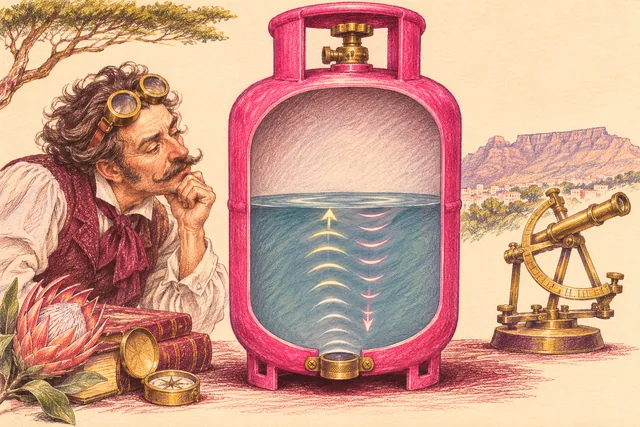
Now for something a little cleverer.
There are electronic devices that can measure the liquid level inside a gas cylinder using ultrasound. Some attach to the base of the cylinder and send a sound pulse through the metal and the liquid. By measuring how long it takes for that pulse to return, the sensor can determine the height of the liquid inside.
It's not entirely unlike the technology used in a fish finder. Except we're looking for LPG rather than something to put on the braai.
Depending on the device, you can see your approximate remaining gas level on your phone or a dedicated display. No drilling holes. No opening the cylinder. No interfering with the gas supply. Quite clever, really.
Is it better than weighing?
Not necessarily better, but potentially more convenient. Ultrasonic sensors have their own little peculiarities:
- They need good contact with the cylinder.
- They must be compatible with the cylinder's material and shape.
- The device needs to be correctly configured.
- Some tell you whether liquid is present at a particular height, while others continuously estimate the remaining contents.
Choose a device intended for LPG cylinders and suitable for the environment in which it will operate. Follow the manufacturer's instructions and don't modify your cylinder to accommodate it.
For the technologically inclined, it's a rather satisfying little gadget. For everyone else, weighing remains an excellent option.
06.A kettle, some warm water and a little ingenuity
There is another old trick for getting a rough idea of where the liquid level is. Gently pour some warm — not boiling — water down the outside of an upright cylinder. After a short while, carefully feel the side of the cylinder.
You may notice a change in temperature around the liquid level. The metal in contact with liquid LPG inside behaves differently from the metal above it, particularly when the cylinder has recently been supplying gas.
It's not always obvious, and it won't tell you whether you have 4.2 kg or 4.7 kg remaining. But it might help distinguish between a cylinder that's nearly empty and one that's still reasonably well stocked.
Think of it as a useful little party trick rather than a measuring instrument. And please, no kettles full of boiling water, blowtorches, heaters or other creative attempts to persuade the cylinder to reveal its secrets.
We're trying to make dinner, not an appearance on the evening news.
07.Why isn't a full gas bottle completely full?
You may have wondered why an LPG cylinder isn't filled entirely with liquid. The reason is quite sensible. Liquids expand when they warm up, and LPG needs sufficient space inside the cylinder to accommodate that expansion.
A properly filled cylinder therefore contains both liquid and vapour space. That space isn't wasted capacity. It's an essential part of the cylinder's design.
When you buy 9 kg, 19 kg or 48 kg of LPG, you're buying a specified mass of gas, not a cylinder filled to the brim.
Proper filling is done by weight, to the permitted filling limit of the particular cylinder. Leave that bit to the people with the filling equipment.
08.Surely there's a better way than checking my gas bottles?
Funny you should ask. We've spent rather a lot of time thinking about this particular problem.
The technology for knowing how much gas is left is useful. But knowing how much gas is left isn't necessarily the thing you're actually interested in.
What you really want to know is: Am I going to run out?
Better still, you probably don't want to think about it at all. Nobody particularly enjoys going outside in their slippers on a cold winter morning to investigate a geyser that's stopped producing hot water.
There are several ways of making gas supply a little less eventful.
Keep a spare cylinder
Simple, effective and reassuringly old-fashioned. A properly designed two-cylinder installation can give you a reserve supply, with an appropriate changeover arrangement where required.
Just remember to arrange a replacement when you start using your reserve. A spare empty bottle is considerably less useful than a spare full one.
Monitor your consumption
A suitable monitoring device can give you an ongoing view of your remaining gas. Once you start understanding your household's consumption patterns, you can get a much better idea of when you'll need your next delivery.
Hand the problem over to us
At The Gas Company, we offer managed gas supply and home gas telemetry solutions. The idea is simple: use technology and a little forward planning to take the guesswork out of keeping your home supplied with gas.
We've been delivering gas since 1947. We rather fancy that by now, ordering gas should be something you do because it's convenient, not because you're standing in a cold shower.
09.Things people ask us
Are pressure gauges completely useless?
Not at all. Pressure is an important measurement in gas installations. Suitable instruments are used by gas practitioners for testing, commissioning and diagnosing problems. They're excellent at measuring pressure. They just happen to be very poor at telling you how many kilograms of LPG are left.
My gauge says empty, but I know there's gas inside. Is something wrong?
Not necessarily. Temperature, demand and the characteristics of your gas supply can influence pressure. However, if your appliances aren't working correctly despite having gas available, have the installation assessed by a registered practitioner. Having gas in the cylinder and being able to supply your appliances correctly are two different things.
Can I shake the cylinder and listen for liquid?
You might hear liquid moving, but you won't get a particularly useful indication of how much remains. Besides, there's little point in manhandling a perfectly innocent gas bottle when better methods exist. Leave it upright and undisturbed.
Does the size of my cylinder affect its pressure?
Not simply because of its size. A 9 kg cylinder and a 48 kg cylinder containing the same LPG mixture at the same temperature can have much the same equilibrium vapour pressure. The larger cylinder does, however, store more fuel and generally has a greater capacity to supply vapour under sustained demand. That's why cylinder sizing matters when you're running several appliances.
How accurate is weighing?
With a suitable scale and a reliable tare weight, it's a very good practical method. There can be small discrepancies due to scale accuracy, cylinder condition and the original tare marking. For the purposes of deciding whether you need to order gas, it's generally more than adequate.
Is an ultrasonic sensor worth buying?
That depends on how you use your gas. If you use LPG daily for cooking, water heating and other appliances, having a convenient indication of your remaining supply can be genuinely useful. If you use a small bottle for the occasional braai, weighing it periodically may be all you need. There is no prize for having the most technologically advanced gas bottle in the neighbourhood. Although we would probably admire it.
Can I work out how many showers I have left?
Indeed you can, approximately. Once you know how much LPG remains, the next question is how quickly you're using it. Water temperature, shower duration, flow rate and geyser efficiency all influence consumption. We've built tools here in The Gas Lab to help you make sense of those numbers. Have a look at our gas geyser consumption calculator.
A little less guesswork. A little more gas.
LPG is a remarkably practical way to cook, heat water and keep your home comfortable. Understanding what's happening inside the cylinder makes it even easier to live with.
You don't need to memorise vapour pressure tables, buy an expensive collection of gadgets or become the neighbourhood expert on thermodynamics. Although, if that sort of thing appeals to you, you're in the right place.
Just remember: Pressure tells you something about the condition of your gas. Weight tells you how much you have.
And a properly managed gas supply means you can spend less time thinking about either.
The Gas Company.
Ask about managed gas supplyA note from the Lab: This guide explains the general principles of domestic LPG storage and measurement. Actual vapour pressure, delivery capacity and sensor performance depend on the LPG mixture, temperature, cylinder and installation. Always use approved equipment suitable for your particular application, and leave alterations to fixed gas installations to a registered gas practitioner.
Further reading: LPG level measurement principles · Ultrasonic measurement example.